
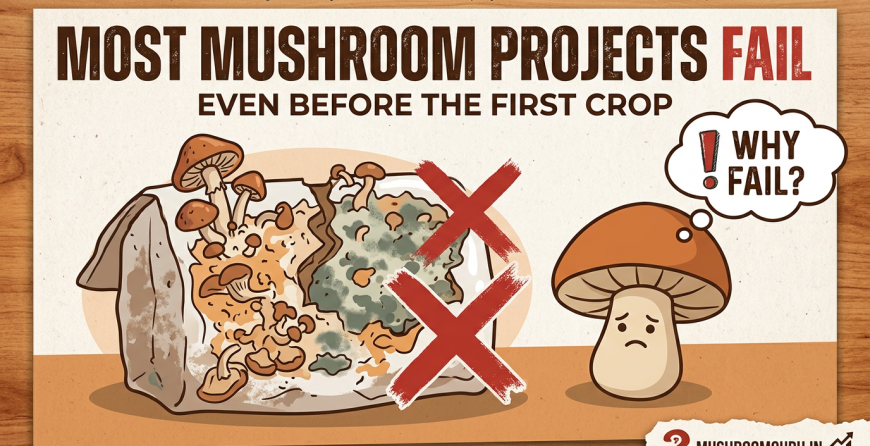
Introduction: Every Successful Mushroom Farm Begins Long Before Construction
Commercial mushroom farming is one of India’s fastest-growing agribusiness opportunities, yet many projects fail before harvesting their first crop. The reasons are rarely poor market demand or lack of investment. Most failures originate during project planning, technology selection, compost management, infrastructure design, and production system integration. This guide explains the hidden mistakes that reduce profitability and shows how scientific planning, professional DPR preparation, integrated system design, and modern production practices can help build a high-performance commercial mushroom enterprise.
Executive Summary
Commercial mushroom farming offers excellent business opportunities, but many projects fail before the first crop due to poor planning rather than lack of investment. A profitable mushroom enterprise requires much more than modern buildings and machinery—it demands scientific feasibility studies, a bankable DPR, efficient project design, high-quality compost, healthy spawn, proper casing, precise environmental control, strict hygiene, and standardized operating procedures. This guide explains the most common reasons behind commercial project failures and demonstrates how integrated system design, continuous technical audits, biological management, and productivity optimization can significantly improve yield, reduce production costs, and ensure long-term profitability. Whether you are a new investor or an existing commercial grower, this article provides practical insights to help you build a sustainable, high-performance mushroom business.
1: The Hidden Reality of Commercial Mushroom Farming
Commercial mushroom farming is not simply about growing mushrooms—it is about managing a highly integrated biological production system. Buildings, machinery, and automation alone cannot guarantee success. Compost quality, spawn performance, casing preparation, environmental control, hygiene, and standard operating procedures work together to determine productivity and profitability. Many entrepreneurs underestimate this complexity and begin with unrealistic expectations. Understanding the true nature of commercial mushroom farming is the first step towards avoiding costly mistakes and building a sustainable, profitable mushroom business
2: The Biggest Myth – A Mushroom Building Is Not a Mushroom Business
Many investors believe that constructing insulated growing rooms and installing modern machinery is enough to ensure success. In reality, a mushroom project is far more than a civil structure or a collection of equipment. Profitability depends on how well compost preparation, spawn quality, casing management, environmental control, hygiene, labour, and standard operating procedures work together as one integrated production system. A well-designed ₹40 lakh project can often outperform a poorly planned ₹1 crore facility because success comes from scientific system design, not simply from higher investment.
Lorem ipsum dolor sit amet, consectetur adipiscing elit. Ut elit tellus, luctus nec ullamcorper mattis, pulvinar dapibus leo.
3: The First Costly Mistake – Starting Without a Scientific Feasibility Study
Many mushroom projects fail because investors begin construction before evaluating whether the project is technically, financially, and commercially viable. A scientific feasibility study examines market demand, raw material availability, climate suitability, utilities, skilled manpower, investment capacity, operational costs, and expected returns. It helps identify risks before money is spent on land, buildings, or machinery. Skipping this step often leads to poor planning, unnecessary expenditure, and low profitability. Every successful commercial mushroom project begins with a realistic feasibility assessment—not with construction or equipment purchase.
4: Why a Bankable DPR Determines Project Success
A Detailed Project Report (DPR) is the blueprint of a commercial mushroom enterprise. It defines the project’s technical design, production capacity, investment requirements, infrastructure, machinery, utilities, manpower, operating costs, profitability, cash flow, and risk analysis. A professionally prepared DPR helps investors make informed decisions, improves the chances of bank loan approval, and prevents costly planning errors. Without a scientific DPR, entrepreneurs often face budget overruns, poor layouts, inappropriate technology selection, and unrealistic financial expectations. A successful mushroom project begins on paper long before construction starts.
5: Poor Project Design – The Mistake That Costs Lakhs Later
A poorly designed mushroom farm cannot be corrected simply by installing better equipment. Incorrect room dimensions, inefficient workflow, inadequate ventilation, poor insulation, improper compost movement, insufficient utility planning, and lack of future expansion provisions reduce productivity and increase operating costs. Every square metre of a commercial mushroom unit should be designed for efficiency, hygiene, labour optimization, and smooth material flow. Scientific project design not only improves production but also minimizes contamination risks, energy consumption, and maintenance costs throughout the life of the project.
piscing elit. Ut elit tellus, luctus nec ullamcorper mattis, pulvinar dapibus leo.
6: Compost Quality – The Real Foundation of Mushroom Profitability
Compost is the engine that drives commercial mushroom production. Even the best spawn, modern growing rooms, and advanced automation cannot compensate for poor-quality compost. Proper raw materials, balanced formulation, controlled moisture, aeration, temperature management, and scientific Phase I and Phase II composting determine nutrient availability and Biological Efficiency (BE). Weak or improperly conditioned compost results in slow spawn run, uneven pinning, lower yields, and increased disease pressure. Successful mushroom farms treat compost production as a scientific manufacturing process because high-quality compost is the foundation of consistent productivity and long-term profitability.
7: Spawn, Casing & Environmental Control – Three Pillars of High Yield
Commercial mushroom production depends on the perfect coordination of spawn quality, casing preparation, and environmental control. Healthy spawn ensures rapid mycelial colonization, while properly prepared casing promotes uniform pinning and sustained cropping. Temperature, relative humidity, carbon dioxide (CO₂), fresh air exchange, and airflow must be precisely managed throughout the crop cycle. Even minor imbalances can delay pinning, reduce mushroom size, increase contamination, and lower Biological Efficiency (BE). High-performing mushroom farms treat these three components as an integrated production system rather than independent operations.
8:Hidden Biological Problems That Begin Before the First Crop
Many mushroom farms unknowingly carry biological problems into the growing rooms long before spawning begins. Poor compost conditioning, incomplete ammonia removal, microbial imbalance, contaminated raw materials, inadequate hygiene, and improper casing preparation create favourable conditions for diseases and reduced crop performance. These hidden issues often remain unnoticed until pinning becomes weak, contamination appears, or yields decline. Scientific compost management, balanced microbial activity, strict sanitation, and preventive monitoring are essential to establish a healthy production system. Preventing biological imbalance is always more effective and economical than trying to correct problems after the crop is affected.
9: Why Many Mushroom Farms Produce Low Yields Despite Heavy Investment
Large investments do not automatically translate into high productivity. Many commercial farms operate below their potential because of inconsistent compost quality, poor environmental control, inadequate SOPs, labour inefficiencies, weak monitoring, and delayed corrective actions. Even small technical deviations repeated over multiple crop cycles can significantly reduce Biological Efficiency (BE), increase production costs, and lower profitability. Successful mushroom enterprises continuously measure, analyze, and optimize every stage of production. High yield is achieved through disciplined management, scientific monitoring, and continuous improvement—not by investment alone
10: Hidden Financial Losses That Slowly Destroy Mushroom Farm Profits
Most mushroom farms do not fail because of one major mistake—they lose money through many small, unnoticed inefficiencies. Low Biological Efficiency (BE), excessive compost consumption, high electricity bills, labour inefficiency, contamination losses, poor grading, inadequate cold chain management, and improper marketing gradually erode profitability. These hidden costs often remain invisible in routine operations but significantly reduce annual returns. Regular technical and financial audits help identify these losses early, allowing farm owners to improve productivity, reduce costs, and maximize profit without increasing production capacity.
11: Why Every Commercial Mushroom Farm Needs a Technical Audit
Many productivity problems remain hidden because farm owners focus only on daily operations rather than system performance. A scientific technical audit evaluates every critical stage, including project design, compost quality, spawning, casing, environmental control, hygiene, disease management, energy use, labour efficiency, and production records. It identifies bottlenecks that reduce yield, increase costs, and affect mushroom quality. Instead of treating symptoms, a professional audit finds the root causes of recurring problems and recommends practical improvements, enabling farms to achieve higher productivity, lower production costs, and sustainable long-term profitability.
12: Scientific System Design – The Secret Behind High-Performance Mushroom Farms
The difference between an average mushroom farm and a highly profitable one lies in scientific system design. Every component—from feasibility study, DPR, infrastructure, composting, spawning, casing, environmental control, harvesting, cold chain, and waste management—must function as one integrated production system. Success is achieved through standard operating procedures (SOPs), continuous monitoring, preventive maintenance, and data-driven decision-making. Modern technologies, including biological compost management, automation, and productivity audits, further improve efficiency. A well-designed system consistently delivers higher yields, better quality, lower production costs, and sustainable profitability over the long term.
13: The Role of Biological Management in Modern Mushroom Farming
Modern commercial mushroom farming increasingly focuses on maintaining a healthy biological production system rather than relying only on corrective measures. Scientific biological management supports efficient composting, improved microbial balance, healthier spawn growth, better casing performance, and a cleaner crop environment. Integrated solutions such as MushroomPlus® are designed to support compost acceleration, ammonia reduction, odour control, disease management, and improved Biological Efficiency (BE) when used as part of a complete production system. Biological management works best alongside good composting practices, environmental control, hygiene, and standard operating procedures, creating a more stable and productive mushroom enterprise.
14: Success Begins Before the First Crop – Build the System, Not Just the Farm
The success of a commercial mushroom project is determined long before the first compost is filled or the first mushroom is harvested. Profitable farms are built on scientific planning, a bankable DPR, proper infrastructure, high-quality compost, reliable spawn, efficient environmental control, disciplined SOPs, and continuous technical monitoring. Every production stage must work together as an integrated system. Investors who prioritize planning over shortcuts consistently achieve better yields, lower production costs, and higher returns. In commercial mushroom farming, systems create profits, while shortcuts create losses.